Can text messages be used in court?
Someone sent you messages that matter: a threat, a promise, an admission, a pattern. Now there is a hearing coming, or a lawyer asked what you have, and you wonder whether texts on a phone even count.
Short answer
Yes. Text messages are used in US courts every day, in family, civil and criminal cases. Whether a judge allows a specific conversation depends on the court and your jurisdiction, but the questions are usually the same: can you show the messages are real and who sent them (authentication), is the statement allowed under the hearsay rules, and is the record complete. Bring a readable copy with dates, times and senders, keep the phone, and ask a lawyer or your court's self-help center how to submit it.
On this page
Which method should you use?
 Exhibit PDFExhibit
Keep the phone either way; of these methods, a complete PDF export is the quickest way to give the judge and the other side the same readable copy, and the only one with a fingerprint anyone can check, while screenshots take roughly an hour for 500 messages and invite questions about what is missing.
The short answer: yes, but someone has to vouch for them
Texts are not a special category of evidence. A judge treats them like letters or emails: useful when they help answer the questions in the case, and only after someone shows they are what you say they are. Courts see them constantly in custody and divorce cases, restraining order hearings, harassment cases, landlord disputes and criminal trials.
What follows is general information about how US courts look at text messages, based on the Federal Rules of Evidence. State courts have their own rules, often similar. It is not legal advice; a lawyer in your state can tell you what applies to your case.
The three questions a judge asks about text messages
1. Are they real, and who sent them? (Authentication.) Under Federal Rule of Evidence 901, the person offering evidence must show enough to support a finding that it is what they claim. For texts, that usually means you testify that these are the messages on your phone, and the surrounding facts point to the sender: their number, their name, things only they would know, and how the conversation fits what happened. A name in your contacts alone is often not enough if the other side disputes it.
2. Does the hearsay rule get in the way? Hearsay is an out-of-court statement used to prove that what it says is true (Rule 801). Many texts get past this. A message from the other party in your case, used against them, is not hearsay under the federal rules, and texts are often used to show that a threat or a message was sent at all, not that its content was true. Your own messages to them can be harder. This is the part where a lawyer helps most.
3. Is it complete and readable? Rule 1001 says a printout of electronic information counts as an original if it accurately reflects it. So a clean, readable copy is fine in principle, as long as it shows what is on the phone. And under Rule 106, if you show part of a conversation, the other side may ask that other parts be shown at the same time. A record that already includes the whole exchange avoids that surprise.
How to prepare your text messages for court
- Do not delete anything, also not the messages that look bad for you. Deleting can look like hiding evidence. Set Keep Messages to Forever in Settings > Apps > Messages.
- Make a complete copy of each relevant conversation with dates, times and senders. On a Mac you can print the conversation from Messages; on the iPhone you need screenshots or an export app.
- Number the pages and keep the conversations in date order, so the judge and the other side can follow the same page.
- Make copies. Courts often want a copy for the judge, one for the other side and one for you. Your court’s self-help center can tell you how many and whether to file them in advance.
- Keep the phone with the messages on it, charged, and do not reset or trade it in until the case is over.
- Write down context separately: who the number belongs to, how you know, and what happened around key messages.
Your situation may add steps. For example, see what to keep for text messages in a custody case or restraining order evidence.
Using Exhibit to make the copy
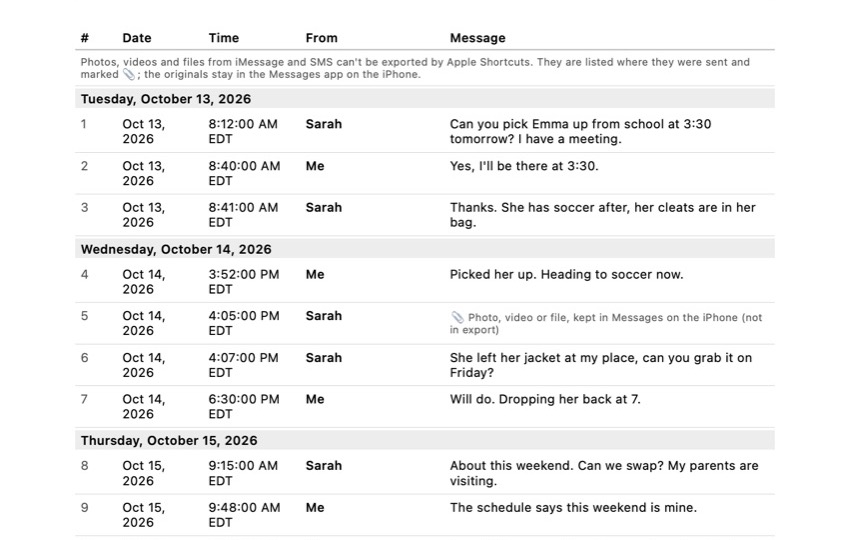
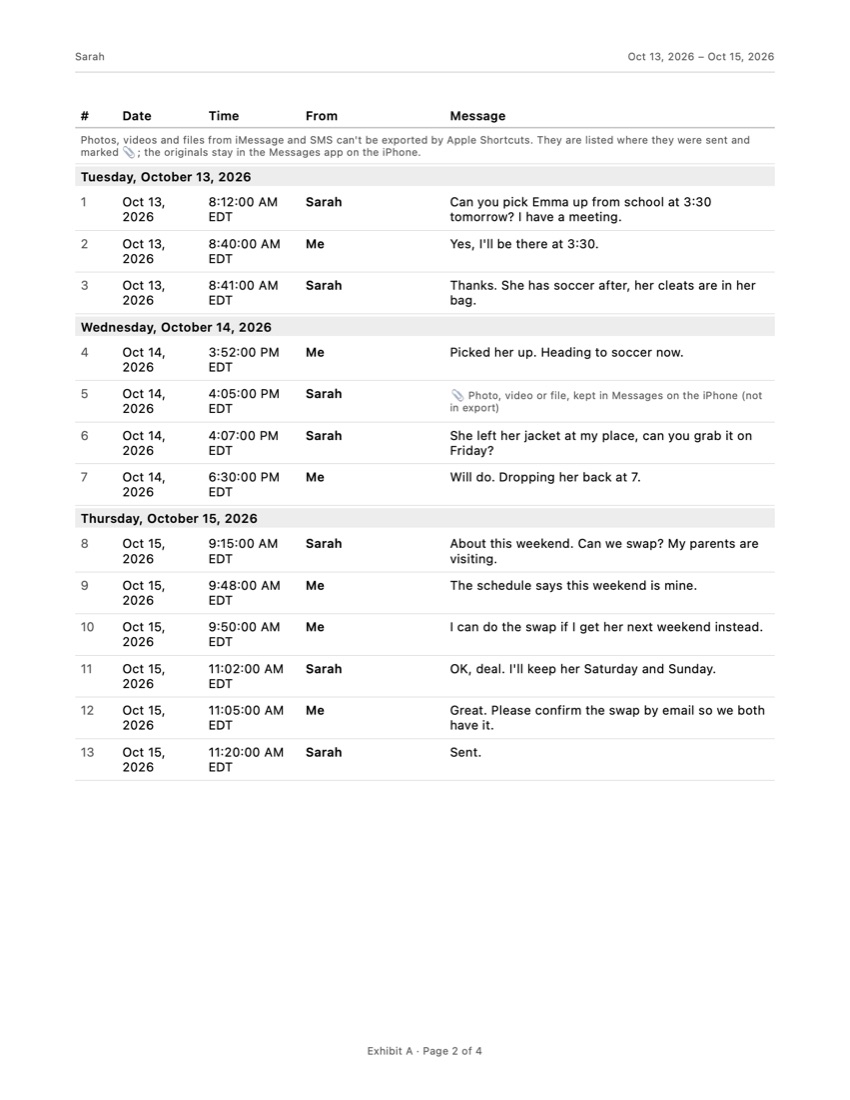
Exhibit turns one iMessage, SMS or WhatsApp conversation into a PDF on the iPhone, without a computer. Every message gets a number, date, time and sender in a table, the time zone is stated, every page says “Page X of Y”, and an integrity page carries a SHA-256 fingerprint so anyone can check later that the file did not change. That helps with the first question above: if the other side says the copy was edited after you made it, anyone can run the check and see whether a single character changed. Of the methods in the table, the Exhibit PDF is the only one that lets the other side check the copy itself, without examining your phone. You can add an electronic signature to your own declaration on that page, or leave the lines blank to sign with a pen.
What it is not: Exhibit does not decide whether a court accepts the PDF; that depends on the court and your jurisdiction, and Exhibit does not give legal advice. The fingerprint shows that the copy did not change after the export; it does not prove who sent the messages, which still comes from the facts around them. It is also not the certification by a qualified person that Rule 902(14) describes for copied data. And Apple Shortcuts cannot export iMessage photos or videos, so the PDF lists where each one was; save those separately. Exhibit is free to download.
The mistake that weakens good messages: cherry-picking
The most common problem is not that texts are fake; it is that only the helpful ones are shown. Three screenshots of insults, without the messages before and after, invite the other side to say they were provoked, joking or answered. Under the rule of completeness, they can ask the judge to see the rest right then, and suddenly your evidence is being read in their order.
Two habits avoid this. First, export or print the whole conversation for the relevant period and mark the key messages, instead of only capturing those. Second, keep times visible on every message: on the iPhone they only appear when you swipe left, so many screenshots have no times at all. A complete, dated record also helps if you are the one reporting harassing texts to the police: it shows the pattern, not just the worst moment.
Frequently asked questions
Are screenshots of text messages enough for court?
Sometimes. Many judges look at screenshots, especially in family and small claims hearings. The weak points are that they rarely show the full conversation, times can be missing, and they are easy to crop. Whether screenshots are enough depends on the court, the case and whether the other side disputes them.
Do I need to bring my phone to court?
Bring it unless your lawyer says otherwise, and do not delete anything. If the other side says a message is fake or edited, the phone is the source a judge or expert can look at. Ask the court in advance whether you may show a phone in the courtroom.
Can deleted text messages be used in court?
If they can be recovered. Deleted messages stay in Recently Deleted on the iPhone for 30 to 40 days, and they may still exist in an older backup or on the other person's phone. A lawyer can ask the other side or the phone carrier for records through discovery or a subpoena.
Can the other person say the texts were not from them?
Yes, and then the judge looks at the surrounding facts: the phone number, the name in your contacts, details only that person would know, replies that fit, and how they acted afterwards. A complete conversation with dates and times makes that picture easier to see than a few loose screenshots.
Do state courts follow the same rules as federal courts?
Not exactly. The Federal Rules of Evidence apply in federal court; each state has its own evidence code, and many are modeled on the federal rules. Family courts and small claims courts often handle evidence more informally. Check your state's court self-help site or ask a lawyer.
Sources
- Cornell LII: Federal Rule of Evidence 901 (authenticating evidence)
- Cornell LII: Federal Rule of Evidence 801 (hearsay definitions)
- Cornell LII: Federal Rule of Evidence 106 (remainder of a statement)
- Cornell LII: Federal Rule of Evidence 1001 (originals and printouts)
- Cornell LII: Federal Rule of Evidence 902 (self-authenticating evidence)
- Utah Courts: Representing yourself (pro se)
Export the whole conversation
Exhibit turns an iMessage, SMS or WhatsApp conversation into one PDF with every date, time and sender, right on your iPhone. No computer, no account.
Get Exhibit, free download