Harassing text messages: how to save them and report them to the police
Someone keeps texting you: insults, threats, messages at night, new numbers after you stop answering. You want it to stop, and you are thinking about blocking them or going to the police. Before you do either, make sure the messages themselves are safe, because the order in which you do things matters.
Short answer
If you are in danger, call 911. Otherwise, save the messages before you block or report anything: on iPhone, Delete and Report Spam removes the conversation, and a blocked number's new messages are not delivered. Do not reply. Keep the phone, write a short log of dates and what happened, and save a copy of the whole conversation with the date, time and sender on every message. Bring that copy to the police or your local non-emergency line. Whether it is a crime depends on your state.
On this page
Which way of saving the texts helps a police report?
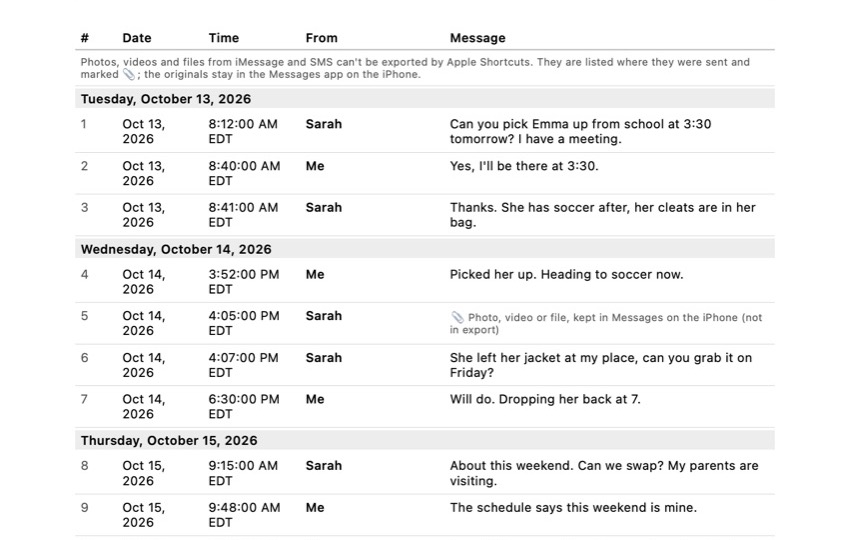
 ExhibitExhibitPDF export
Screenshots work for a few messages, but a pattern of weeks quickly becomes about 50 images, each needing a swipe for the time, roughly an hour or more. An export takes about 5 minutes per conversation and gives the officer every message in order. Never use Report Spam on messages you may need.
Export the conversation with Exhibit
What to do now
Do not reply and do not delete. Set Keep Messages to Forever, save a copy of every conversation with the sender (including from new numbers), and start a dated log. If a message threatens you, call 911.
What not to rely on
Tapping Delete and Report Spam (it deletes the thread), blocking before you have saved anything, the phone company keeping the words (carriers often keep only who texted whom and when), or one screenshot of the worst message.
What Exhibit does
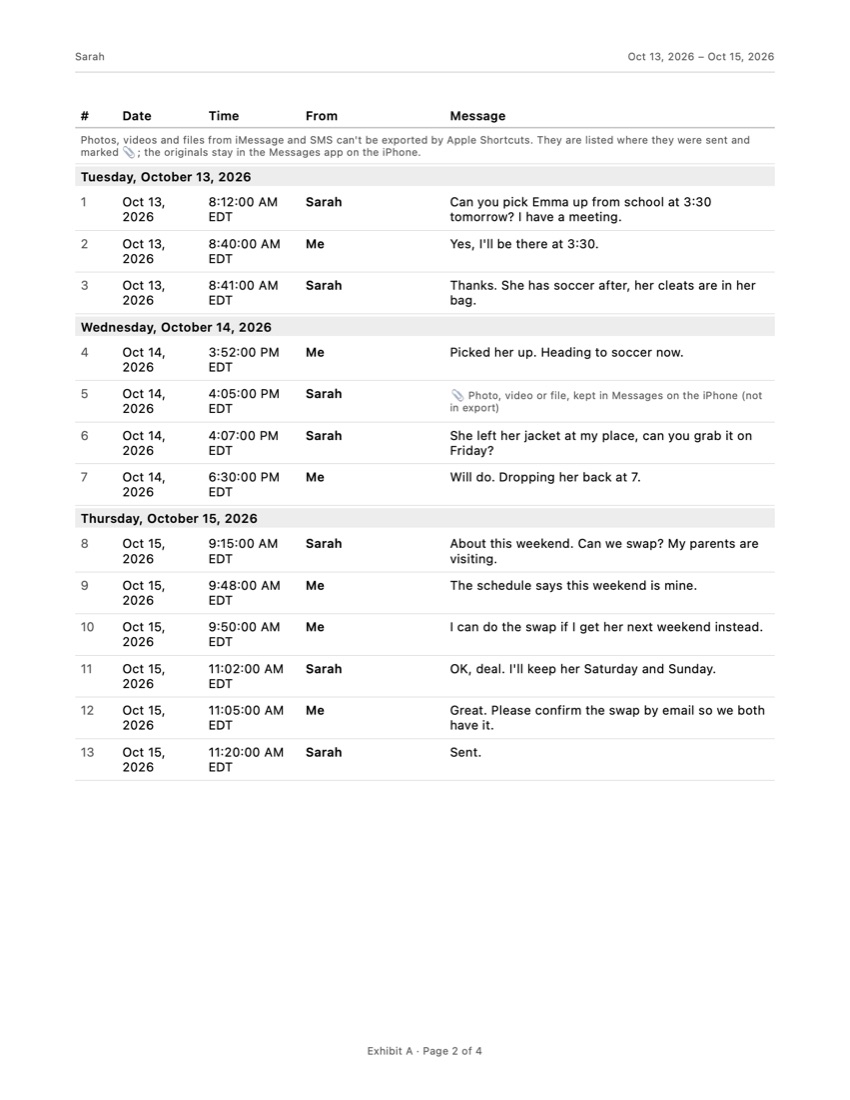
Exports one iMessage, SMS or WhatsApp conversation for a period you choose to a PDF, CSV or TXT file on your iPhone. The PDF numbers every message with its date, time and sender, states the time zone, has page numbers and an integrity page with SHA-256 fingerprints. Processed on your iPhone, not uploaded.
What Exhibit does not do
Identify who is behind an unknown number, contact the police for you, decide whether something is a crime, or export iMessage and SMS photos and videos (the PDF lists where each one was). It does not give legal advice.
What a lawyer decides
Whether the messages break your state's harassment or stalking law, whether you can get a protective or restraining order, and what the police or prosecutor need from you.
What to keep
The phone, the original conversations, a backup, the exported copies, your log, the police report number and the officer's name.
The problem
Harassment by text rarely comes as one message. It is usually a pattern: dozens of texts, at odd hours, after you asked the person to stop, sometimes from new numbers. That pattern is exactly what police and courts look at, and it is also what gets lost first.
The iPhone makes it easy to lose it. When a message comes from an unknown sender, Messages offers a Report Spam link, and the button it leads to is called Delete and Report Spam. Apple’s own instructions show that it removes the conversation. Blocking is safer, but once a number is blocked, its messages are no longer delivered, so anything the person sends afterwards is not on your phone.
What can go wrong
- Reporting before saving. Delete and Report Spam deletes the thread from your iPhone, and with Messages in iCloud from your other devices too.
- Blocking too early. Blocked messages are not delivered. If the harassment goes on, you have no record of it.
- Replying. An angry reply can escalate things and can end up in the same record as their messages.
- One screenshot. The worst message alone, without the date or the many messages around it, does not show a pattern.
- Losing the phone. Trading it in, resetting it or letting automatic deletion run (Keep Messages: 30 Days or 1 Year) removes the original.
- Investigating yourself. Calling back, tracing the number or logging in to someone’s accounts can put you at risk and cause legal problems.
Checklist
- In danger? Call 911. Everything else can wait.
- Do not reply, and do not delete. Not even your own messages.
- Stop automatic deletion: Settings > Apps > Messages > Keep Messages: Forever. Our guide on saving text messages on iPhone covers this and backups.
- Save every conversation with the sender, including the ones from new numbers, as a complete copy with dates, times and senders.
- Save photos, voice messages and voicemails they sent separately.
- Start a log: date, time, number, what was said or done, and how it affected you (missed work, changed routes).
- Then decide about blocking, and only use Report Spam on messages you do not need.
- Report it: 911 for threats, otherwise your police non-emergency line or station. Bring your copy and your log, and write down the report number.
What to bring to the police
Officers have little time to scroll through a phone, and you may not want to leave yours behind. A printed copy of the whole conversation lets them see the pattern at once: how many messages, over what period, at what times. Our guide on printing text messages from an iPhone compares the ways to do that.
Exhibit exports one conversation at a time on the iPhone, without a computer. You add the free shortcut once, choose the conversation and the period, and get a PDF with every message numbered, with its date, time and sender, the time zone, “Page X of Y” on every page, and an integrity page with SHA-256 fingerprints so anyone can check later that the file was not changed. When the harassment continues, you can export again for the new period. Your conversations are processed on your iPhone and are not uploaded.
The limits: photos, videos and files in iMessage and SMS cannot be exported through Apple Shortcuts, so the PDF lists where each one was and you save them separately. Exhibit is free to download. It cannot find out who is behind a number, and it does not decide whether a court or the police accept a copy; keep the phone and the original messages too.
When it is more than annoying
The police usually act when messages threaten you, keep coming after you asked the person to stop, or make you afraid for your safety. A single rude message is often not enough. If the sender is a former partner, a family member or someone who knows where you live, tell the officer, because different laws and protections may apply. Many states also let you ask a court for a civil harassment or protective order; a victim advocate, your court’s self-help center or a lawyer can tell you what fits your situation.
Frequently asked questions
Is text message harassment a crime?
It can be. Most states have laws against harassing or threatening communications, and federal law also covers some repeated or anonymous messages sent to harass a specific person. Whether a particular set of texts is a crime depends on what they say, how often they came and your state's law. The police or a prosecutor decide whether to charge.
Should I block the number?
Your safety comes first, so blocking is fine, but save the conversation first. Once a number is blocked, its new messages are not delivered, so you will not have them if the harassment continues. Some people keep a number unblocked while they gather a record; talk it over with the police or a victim advocate.
Do the police need my phone?
Often they want to see the messages on the phone, and in some cases they may ask to keep it or copy it. Bringing a complete, printed copy of the conversation makes it easier to report without handing over your phone right away. Ask the officer what they need.
What if the texts come from different or unknown numbers?
Save each conversation, and note in your log why you think it is the same person (the same wording, things only they would know, timing). Do not try to trace the number yourself. Police can ask the phone company for records with legal process.
Can I get a restraining order for harassing texts?
In many states, yes. Courts offer civil harassment or protective orders, and repeated unwanted messages can be part of the reason. The rules and forms differ by state; your court's self-help center or a lawyer can explain them.
Sources
Export the whole conversation
Exhibit turns an iMessage, SMS or WhatsApp conversation into one PDF with every date, time and sender, right on your iPhone. No computer, no account.
Get Exhibit, free download