How do you authenticate text messages for court?
You have texts that matter to your case, and someone told you they need to be authenticated. Or the other side already said the messages are fake, edited, or not from them. You want to know what proof actually helps.
Short answer
To authenticate text messages, you show the court enough to support that they are what you say: real messages, from that person, unchanged. Usually that starts with your own testimony that the copy matches your phone, plus facts tying the sender to the messages: their phone number, details only they would know, replies that fit, or their own admission. If the sender is disputed, carrier records or a forensic exam of a phone can add more. The bar is often described as low, but what a court accepts depends on the court and your jurisdiction.
On this page
Which method should you use?
 Exhibit PDF + your testimonyExhibit
Of these methods, your testimony with a complete, dated copy is the quickest and the one you can do yourself; the fingerprint in an Exhibit PDF lets anyone check the copy did not change, but who sent the messages still comes from the facts around them, and carrier records or a forensic exam are for when authorship is seriously disputed.
What “authenticate” means for text messages
Authentication is the court’s first question about any exhibit: is this what you say it is? Under Federal Rule of Evidence 901, the person offering a text message has to produce enough evidence to support a finding that it is genuine. It does not have to be proof beyond doubt; the judge decides whether a reasonable person could accept it, and the other side can still argue it is fake.
For text messages that usually means three things: the messages are real and come from this conversation, the person you say sent them did send them, and the copy shows them as they were. State courts have their own evidence codes, many modeled on the federal rules. A Wisconsin appeals court, for example, called authenticating texts a low standard that needs no special rules, while some courts in other states have asked for more before tying a message to a person. This page is general information, not legal advice.
Six ways to show your text messages are real
1. Your own testimony. Rule 901(b)(1) allows a witness with knowledge to say an item is what it claims to be. You explain that you received the messages on your phone, that the copy is accurate, and how you know who sent them. In most hearings this is where authentication starts and often where it ends.
2. The phone number. A contact name is only a label you typed. The number or email address behind it is what links the conversation to a person. Be ready to say how you know the number is theirs: they gave it to you, you have called it, it is on their documents, or others reach them there.
3. What the messages say. Rule 901(b)(4) lets content and circumstances do the work: nicknames, private details, plans that then happened, a photo only they had. A message saying “running late, at your mom’s” right before they arrived at your mother’s house points to the sender better than any label.
4. Replies and what happened next. When you write to a number and the answers fit, or the person acts on what was said, that conversation pattern supports who was on the other end.
5. The other person admits them. In many civil cases, including divorce and custody cases, one side can formally ask the other to admit that specific messages are genuine (in federal court, Rule 36 requests for admission). An admission settles the question. A lawyer or the court’s self-help center can explain how this works in your court.
6. Records and examination. If authorship is seriously disputed, a lawyer can subpoena carrier records showing that texts went between two numbers at certain times, or a forensic examiner can look at the phone itself. Both cost time and money and are usually saved for cases where they are needed.
Show the number behind the contact name
Here is what most advice skips: a screenshot of a conversation shows the name you saved, not the sender’s number. If you saved them as “Jake” or “Mom”, that is what the court sees, and it proves nothing about who wrote the messages. Anyone can save any number under any name.
On iOS 26, tap the name or picture at the top of the conversation to open the details, then tap the contact to see the phone number or email address the messages came from. Take a screenshot of that screen too, or write the number down with the date, and keep it with your copy of the conversation. Also note whether a message came from an email address rather than a number: iMessages can be sent from any Apple device signed in to the sender’s Apple Account, such as an iPad or Mac, which can matter if they say someone else used their account.
Making a copy you can stand behind
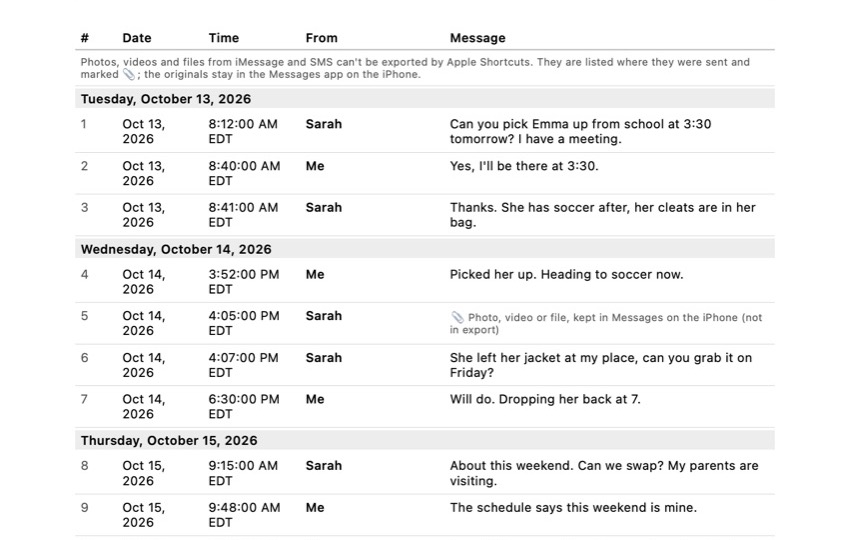
A good copy makes your testimony easier. It should show every message in the period that matters, not only the useful ones, with the date, time and sender on each, page numbers, and nothing cropped. Courts often want copies for the judge and the other side; see how to print text messages for court for the free ways to make them.
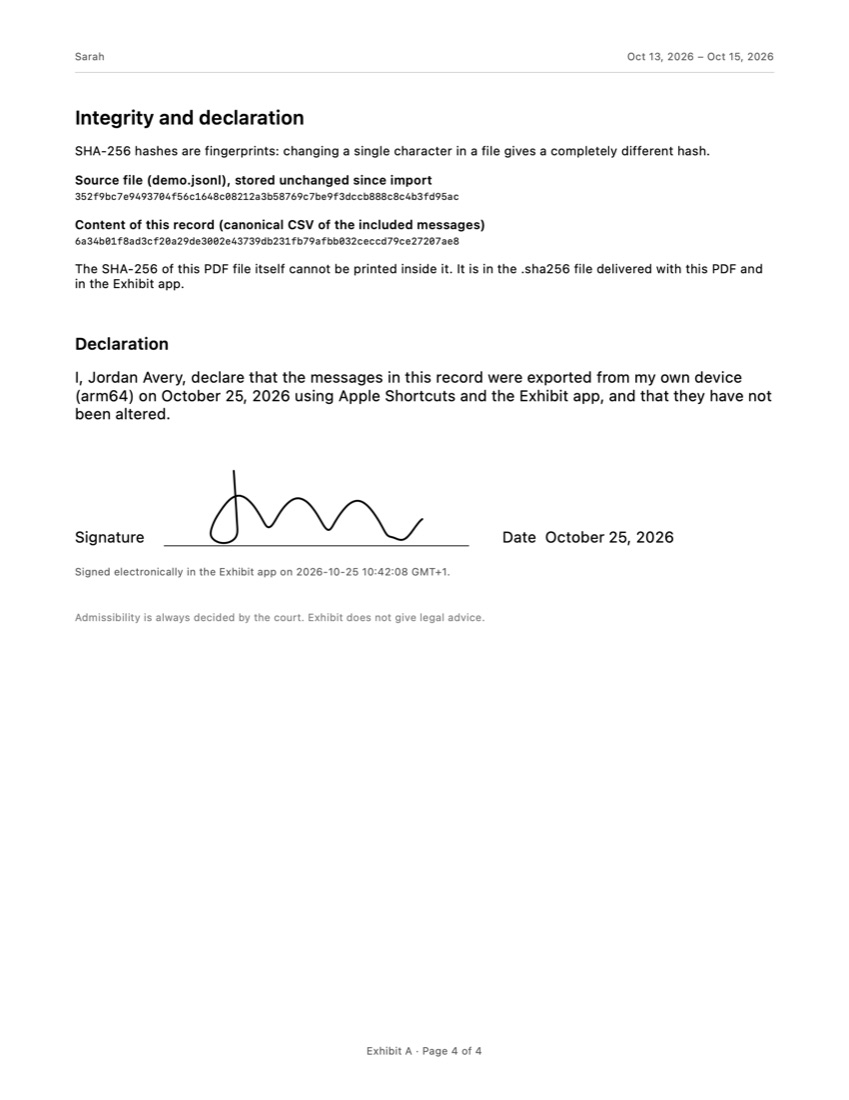
Exhibit can make that copy on the iPhone. It turns one iMessage or SMS conversation, or a period you choose, into a PDF that lists each message with its number, date, time and sender, states the time zone, and numbers every page. The integrity page carries a SHA-256 fingerprint of the content, so if the other side claims the copy was edited after you made it, anyone can run the check and see whether one character changed. You can sign the short declaration on that page electronically in the app, or leave it blank to sign with a pen; some courts require a handwritten or notarized signature.
Be clear about what it does not do. The fingerprint shows the file has not changed since the export; it does not prove who typed the messages, which still comes from the six kinds of proof above. It is not the certification by a qualified person that Rule 902(14) describes for data copied from a device. Apple Shortcuts cannot export iMessage photos or videos, so the PDF lists where each one was; save those separately. Whether a court accepts the copy depends on the court and your jurisdiction. Exhibit is free to download.
Keep the phone and the originals
Whatever copy you bring, the phone is the source. Do not delete the conversation, do not delete the other person’s contact, and do not reset, sell or trade in the phone until the case is over. Set Keep Messages to Forever in Settings > Apps > Messages so older messages are not removed automatically. If the other side challenges a message, the phone is what a judge or examiner can look at.
For the bigger picture, including hearsay and the rule of completeness, read can text messages be used in court. Preparing for a specific hearing? See what to collect for restraining order evidence.
Frequently asked questions
Is a screenshot enough to authenticate a text message?
A screenshot can be authenticated when someone who saw the messages, usually you, testifies that it accurately shows what was on the phone. The weak points are what it leaves out: the phone number behind the contact name, the times, and the messages around it. If the other side disputes it, the judge may want more.
What if the other person says someone else sent the texts?
Then the question is authorship, and the court looks at the whole picture: whose number it is, whether they had the phone, details in the messages, how they replied or acted afterwards. A message coming from a number is not always proof that the owner typed it, so collect the surrounding facts, not just the texts.
Do I need an expert to authenticate text messages?
Usually not. In most hearings the person who received the messages explains what they are and how they know who sent them. A forensic examiner tends to come in when one side claims messages were faked or deleted, or when the case is serious enough to justify the cost.
Can I get the other person's phone records?
Not on your own. Phone carriers release records about another person's account only with a subpoena or court order, which a lawyer or the court process can request. Many carriers keep dates, times and numbers for texts but not the words, and only for a limited time.
Do the same rules apply in family court and small claims?
The idea is the same, but the procedure is often more relaxed. Many family and small claims judges simply ask you to identify the messages and explain who sent them. State evidence codes differ, so check your court's self-help site or ask a lawyer.
Sources
- Cornell LII: Federal Rule of Evidence 901 (authenticating or identifying evidence)
- Cornell LII: Federal Rule of Evidence 902 (evidence that is self-authenticating)
- Cornell LII: Federal Rule of Civil Procedure 36 (requests for admission)
- Wisconsin State Public Defender: How to authenticate a text message
- California Courts Self-Help: How to introduce exhibits at trial
Export the whole conversation
Exhibit turns an iMessage, SMS or WhatsApp conversation into one PDF with every date, time and sender, right on your iPhone. No computer, no account.
Get Exhibit, free download