Co-parenting text messages: how to write them and keep a record
You share children with someone you no longer live with, and most of your contact happens by text: pickups, school, doctors, money, last-minute changes. Things are tense, there is a custody order or one may be coming, and you want your messages to be a record that helps the children instead of one that turns into a fight.
Short answer
Write every text as if a judge will read it: short, polite and about the children. Do not answer insults; answer only the practical question. Keep everything, set Keep Messages to Forever, and keep a simple communication log with dates and what happened. Every few months, save a copy of the whole thread with the date, time and sender on every message. If you move to a co-parenting app, save the old texts first, because the app only records what is sent in it.
On this page
Which co-parenting record covers what you need?
 ExhibitExhibitPDF export of your texts
No single record does everything. A co-parenting app keeps a clean record from the day you both start using it; an export covers the texts you already have, in about 5 minutes instead of roughly an hour or more of screenshots. A short daily log ties the two together.
Export the conversation with Exhibit
What to do now
Set Keep Messages to Forever, make a backup, and start a dated log today. Before your next text, read it once more and remove anything that is not about the children.
What not to rely on
Remembering who said what, the thread staying on your phone for years, a co-parenting app covering messages from before you joined, or a few screenshots of the other parent's worst texts.
What Exhibit does
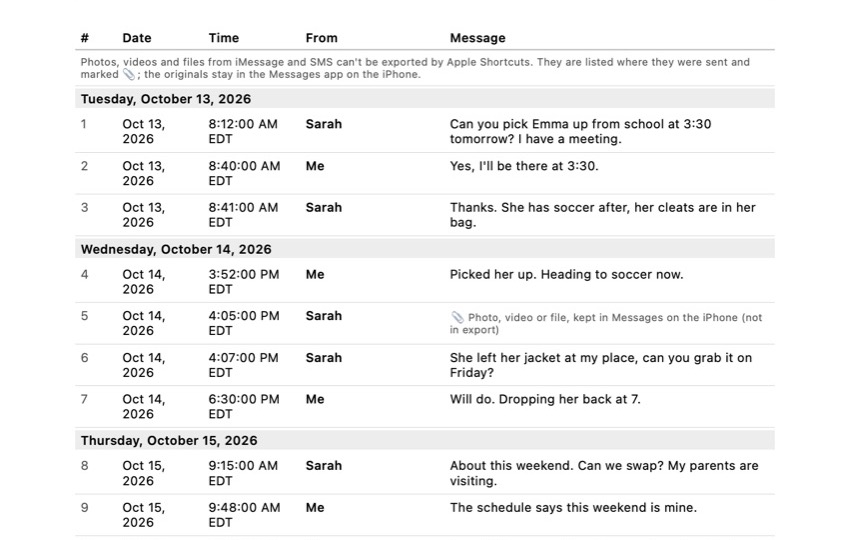
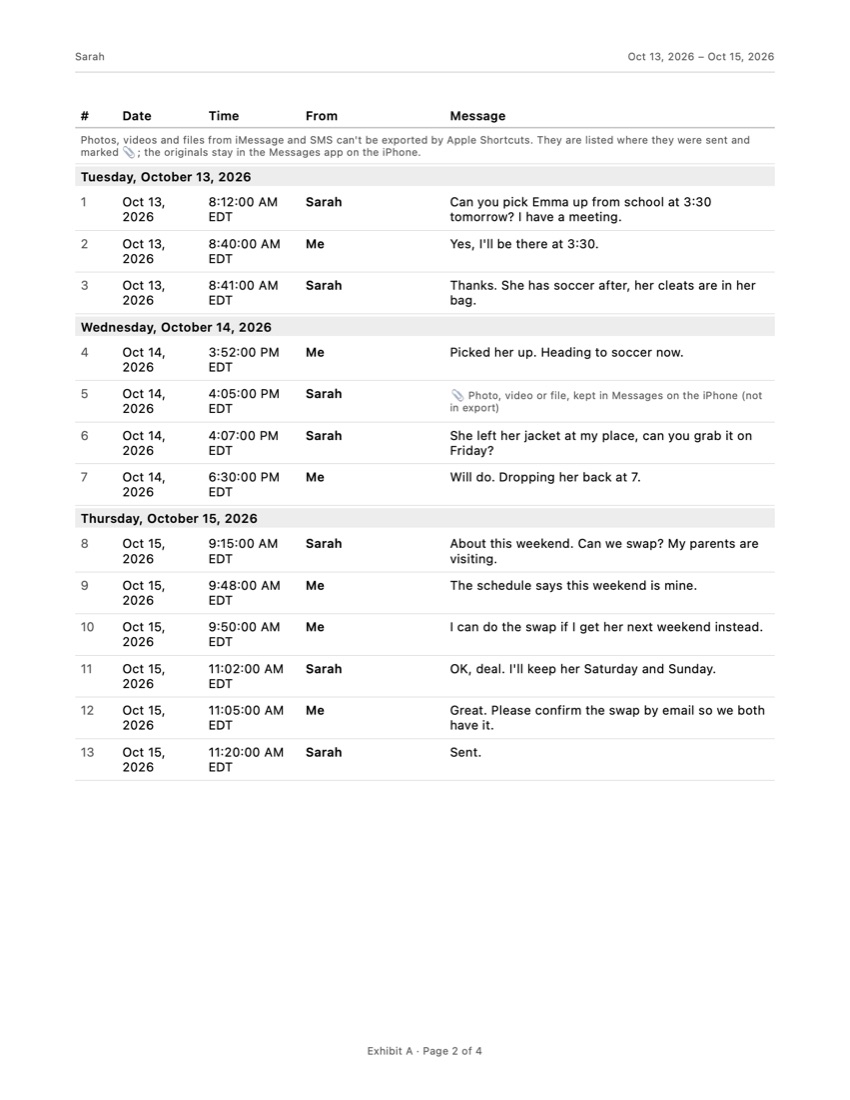
Turns one iMessage, SMS or WhatsApp conversation, for a period you choose, into a PDF where every message is numbered with its date, time and sender, with the time zone, page numbers and an integrity page with SHA-256 fingerprints. Processed on your iPhone, not uploaded.
What Exhibit does not do
Show when a message was read, check the tone of your messages, replace a co-parenting app the court ordered, give legal advice, or export photos and videos from iMessage or SMS (the PDF lists where each one was).
What a lawyer decides
Whether your order requires a specific app, how messages should be presented in your court, and what to do if the other parent ignores the order or uses messages to harass you.
What to keep
The phone, the full thread, a backup, exported copies by period, your log, and any reports from a co-parenting app you use.
The problem
When parents live apart, the message thread becomes the place where the parenting plan actually happens. Months later, if there is a dispute about a missed weekend, a school decision or money, that thread is often the only record of what was agreed. In a custody case it may be read by lawyers, a mediator or a judge, who look at how each parent communicates as much as at what was said.
Two things make this hard. Texts are written quickly, often in the middle of a disagreement. And the record is scattered: some in Messages, some in WhatsApp, some in a co-parenting app, some only in memory.
How to write texts a judge could read
- Keep it short. One topic per message. If it needs more than a few sentences, it may be better as a call or an email.
- Stick to the children. Times, places, school, health, costs. Leave out the past relationship.
- Be polite even when they are not. “Thanks, I’ll pick her up at 5” reads well months later; a sharp reply does not.
- Ignore the bait. Answer the practical question and skip the insult. You do not need to defend yourself in every message.
- Confirm changes in writing. If you agree something by phone, send a one-line text: “As discussed, I’ll have the kids Saturday instead of Sunday.”
- Wait before sending when you are angry. Draft it, read it later, then decide.
- Never use the children as messengers, and do not text about the case through them.
What can go wrong
- Automatic deletion. With Keep Messages set to 30 Days or 1 Year, the iPhone deletes older texts on its own. Years of co-parenting can vanish this way.
- Switching to an app without saving the texts. An app such as OurFamilyWizard keeps a record of messages sent in the app, and its messages cannot be edited or deleted after sending. It does not include the texts you sent before. Save those first.
- Messages in several places. A separate WhatsApp chat, a group with grandparents, or a new number each need their own copy.
- A new phone. Moving to a new phone without transferring messages, or trading in the old one, loses the originals.
- Selective copies. Saving only the other parent’s worst messages invites the question of what you left out. Keep the whole thread.
Checklist
- Settings > Apps > Messages > Keep Messages: Forever. Our guide on how to save text messages on iPhone shows each step.
- Make a backup to iCloud or a computer.
- Start a communication log: date, what happened, and where the message is.
- Save a copy of the whole thread now, and again every few months or before any hearing or mediation.
- Save photos sent in the thread separately (touch and hold, then Save).
- If you move to an app, export the old texts first and keep them with the app’s reports.
- Check your order for rules about how and how quickly you must communicate.
- Give your lawyer everything, including your own messages you are not proud of.
Texts, an app, or both?
Co-parenting apps are built for this: messages cannot be changed after sending, you see when the other parent first read them, and you can download reports. Some courts order parents to use one; a Texas county, for example, publishes a standard order requiring both parents to communicate through OurFamilyWizard. The catch is that both parents have to join, it often costs money, and the record starts on the day you begin.
For the texts you already have, an export fills the gap. With Exhibit you add the free shortcut once, pick the conversation and the period, and get a PDF on your iPhone. Every message is numbered with its date, time and sender, so your log can say “see message 214” instead of describing it. The time zone is stated, every page has “Page X of Y”, and the integrity page has SHA-256 fingerprints so anyone can check later that the file did not change. Your conversations are processed on your iPhone and are not uploaded. Exhibit is free to download.
The limits: Exhibit does not show read receipts, does not replace an app your court ordered, and cannot export iMessage or SMS photos and videos through Apple Shortcuts (the PDF lists where each one was). It does not give legal advice. When the case itself comes, read what to save for text messages in a custody case, and if you are also divorcing, what to keep for text messages in a divorce.
Frequently asked questions
Can co-parenting text messages be used in court?
Often, yes. In custody matters courts look at how parents communicate and whether they can cooperate, and texts are a direct record of that. Whether a particular message is used depends on the court and your state's rules, and someone usually has to show who sent it. Your lawyer decides how to present them.
What should a co-parenting communication log include?
The date and time, what happened (a late pickup, a cancelled visit, a school call), who was involved, and where the related message is. Keep it factual and short, write it the same day, and do not add opinions about the other parent. A log points to the messages; it does not replace them.
Do I have to use a co-parenting app?
Only if your order or agreement says so. Some courts order parents to communicate through an app such as OurFamilyWizard or TalkingParents; others leave it to the parents. Check your most recent custody order, and ask your lawyer or the court's self-help center if you are unsure.
How fast should I reply to my co-parent?
Within a reasonable time for what is asked, and faster for anything urgent about the children. Some orders set a response time; follow it if yours does. Replying late at night or in anger rarely helps. It is fine to answer the practical question and leave the rest.
What if the other parent sends long, hostile messages?
Do not reply to the insults. Answer only the part about the children, briefly. Keep every message, note the date in your log, and tell your lawyer if it becomes a pattern. If you feel unsafe, contact the police or a domestic violence hotline.
Sources
Export the whole conversation
Exhibit turns an iMessage, SMS or WhatsApp conversation into one PDF with every date, time and sender, right on your iPhone. No computer, no account.
Get Exhibit, free download